Tell us about the job
Takes about a minute. No obligation.
A heat pump that stops heating or cooling in Perry County is almost certainly failing for reasons a contractor can trace to the equipment itself. 105 severe weather events were recorded in Perry County, Pennsylvania between 2015 and 2024. At that rate, severe weather is real but not so relentless that it becomes the default explanation for a worn compressor or a failing reversing valve. A contractor here will look at refrigerant levels, electrical connections, and the age of the components before blaming the climate, because the climate alone rarely accounts for what they find.
Ductwork in a house built for oil or gas heat was sized and routed for that equipment, and what a contractor finds when they open a heat pump running in that infrastructure is often friction damage, leaking joints, or refrigerant lines that have been spliced more than once. Half the homes in Perry County, Pennsylvania were built in 1976 or earlier (2020-2024 ACS 5-year). That history means a repair call here can surface parts that predate current manufacturing runs, and a contractor has to verify what is still produced before they can commit to a scope. The condition of the opened system, not its age on paper, is what sets the price.
The Parts of a Heat Pump a Contractor Checks First
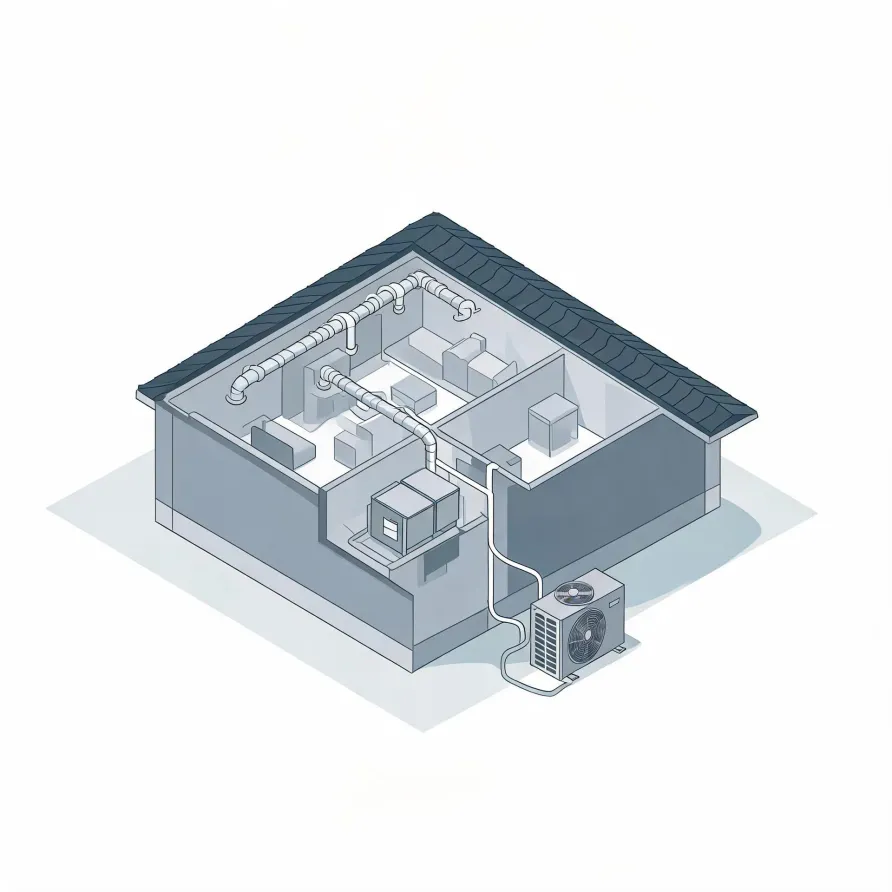
The outdoor unit is usually where a diagnosis starts. It houses the compressor, which moves refrigerant through the system, and the condenser coil, which releases or absorbs heat depending on the season. When the system is not heating or cooling properly, a contractor will look here first, checking whether the compressor is running and whether the coil is transferring heat the way it should.
Inside the house, the air handler holds the evaporator coil and the blower fan. The coil does the indoor heat exchange, and the fan pushes conditioned air through the ducts. Connecting the two units is the refrigerant line set, and the reversing valve inside the outdoor unit is what lets the system shift between heating and cooling modes. Any of these can be the source of a problem.
The drawing shows a typical heat pump layout, and a licensed contractor will assess exactly which components apply to your specific system.
Find a contractor in Perry CountyPerry County, by the numbers
105 severe weather events were recorded in Perry County, Pennsylvania between 2015 and 2024.
NOAA National Centers for Environmental Information, Storm Events Database, bulk CSV export, events 2015-01-01 through 2024-12-31.Half the homes in Perry County, Pennsylvania were built in 1976 or earlier (2020-2024 ACS 5-year).
U.S. Census Bureau, 2020-2024 American Community Survey 5-Year EstimatesPerry County, Pennsylvania holds 20,049 housing units (2020-2024 ACS 5-year).
U.S. Census Bureau, 2020-2024 American Community Survey 5-Year EstimatesOwners occupy 81.8% of the occupied homes in Perry County, Pennsylvania (2020-2024 ACS 5-year).
U.S. Census Bureau, 2020-2024 American Community Survey 5-Year EstimatesRules & Standards Governing Heat Pump Repair in Perry County, Pennsylvania3 sourced rules and standards
What Perry County, Pennsylvania Requires for HVAC Repair Work
Pennsylvania names the trade in its own definition: installing central heating or air conditioning is a home improvement under the Act, whether or not the equipment is affixed — so an HVAC installation is work the registration requirement reaches.
A Pennsylvania registration displaces the local one: no political subdivision may require a home improvement contractor to register, license or pay a fee on top of it, though building permits and local code enforcement still apply.
Pennsylvania requires home improvement contractor registration rather than a licence: nobody may hold themselves out as a contractor, or perform any home improvement, without first registering with the Bureau of Consumer Protection.
Severe Weather Events in Perry County, Year by Year
Weather in Perry County puts real demand on heat pumps, which have to work harder and cycle more often as conditions shift. How often that pressure hits shapes how quickly components wear and how soon repair work becomes necessary.
105 severe weather events, 2015–2024. Source: NOAA National Centers for Environmental Information, Storm Events Database.