Tell us about the job
Takes about a minute. No obligation.
A heat pump running in Chester County has been working against real weather pressure for years, and that shapes what a contractor looks for when something fails. 543 severe weather events were recorded in Chester County, Pennsylvania between 2015 and 2024. At that rate, wear on the reversing valve, refrigerant lines, and compressor is worth checking before a contractor calls a repair straightforward. A part that tests marginal in the shop may have been marginal for a while, pushed there by repeated heavy-demand cycles rather than by any single failure point.
Half the homes in Chester County, Pennsylvania were built in 1983 or earlier (2020-2024 ACS 5-year). A heat pump installed into a house that old has been running through seasonal swings in a shell that predates the equipment by a wide margin, and the stress shows up first at the refrigerant lines and coil surfaces rather than the electrical controls or the reversing valve. When a contractor opens the system, corroded fittings and coil fouling are the likeliest finding, and parts availability for a unit that has lived that long in that kind of structure becomes a real constraint on what the repair actually costs.
The Parts of a Heat Pump a Contractor Checks First
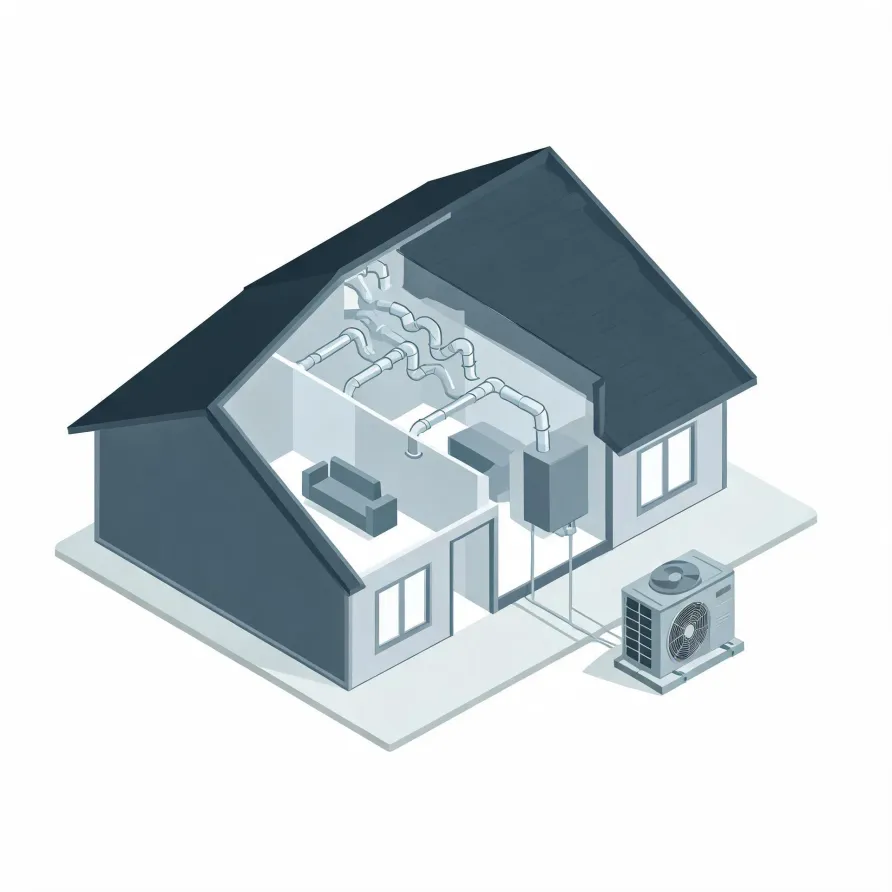
The outdoor unit is usually the first thing a homeowner notices, and it is often the first place a contractor looks. It houses the compressor, which does the hardest work in the system, and the outdoor coil, which moves heat between the refrigerant and the outside air. When either of those is the problem, symptoms show up across the whole house.
Inside the house, the air handler holds the indoor coil and the blower fan, which pulls air across the coil and pushes it through the home. The refrigerant lines running between the two units and the reversing valve, which tells the system whether to heat or cool, are also common points a contractor examines when the system is not behaving as it should.
The drawing shows a general layout of these components, and a licensed contractor determines what applies to the specific equipment and configuration in your house.
Find a contractor in Chester CountyChester County, PA, by the numbers
543 severe weather events were recorded in Chester County, Pennsylvania between 2015 and 2024.
NOAA National Centers for Environmental Information, Storm Events Database, bulk CSV export, events 2015-01-01 through 2024-12-31.Half the homes in Chester County, Pennsylvania were built in 1983 or earlier (2020-2024 ACS 5-year).
U.S. Census Bureau, 2020-2024 American Community Survey 5-Year EstimatesChester County, Pennsylvania holds 212,491 housing units (2020-2024 ACS 5-year).
U.S. Census Bureau, 2020-2024 American Community Survey 5-Year EstimatesOwners occupy 75.1% of the occupied homes in Chester County, Pennsylvania (2020-2024 ACS 5-year).
U.S. Census Bureau, 2020-2024 American Community Survey 5-Year EstimatesCodes & Standards Covering Heat Pump Repair in Chester County, Pennsylvania3 sourced rules and standards
What Chester County, Pennsylvania Requires for HVAC Repair Work
Pennsylvania names the trade in its own definition: installing central heating or air conditioning is a home improvement under the Act, whether or not the equipment is affixed — so an HVAC installation is work the registration requirement reaches.
A Pennsylvania registration displaces the local one: no political subdivision may require a home improvement contractor to register, license or pay a fee on top of it, though building permits and local code enforcement still apply.
Pennsylvania requires home improvement contractor registration rather than a licence: nobody may hold themselves out as a contractor, or perform any home improvement, without first registering with the Bureau of Consumer Protection.
Severe Weather Events in Chester County
Heat pumps in Chester County work against outdoor conditions year-round, and hard weather accelerates wear on components that are already running at capacity. How often those conditions arrive shapes how much repair pressure local equipment faces.
543 severe weather events, 2015–2024. Source: NOAA National Centers for Environmental Information, Storm Events Database.